The Phoenix
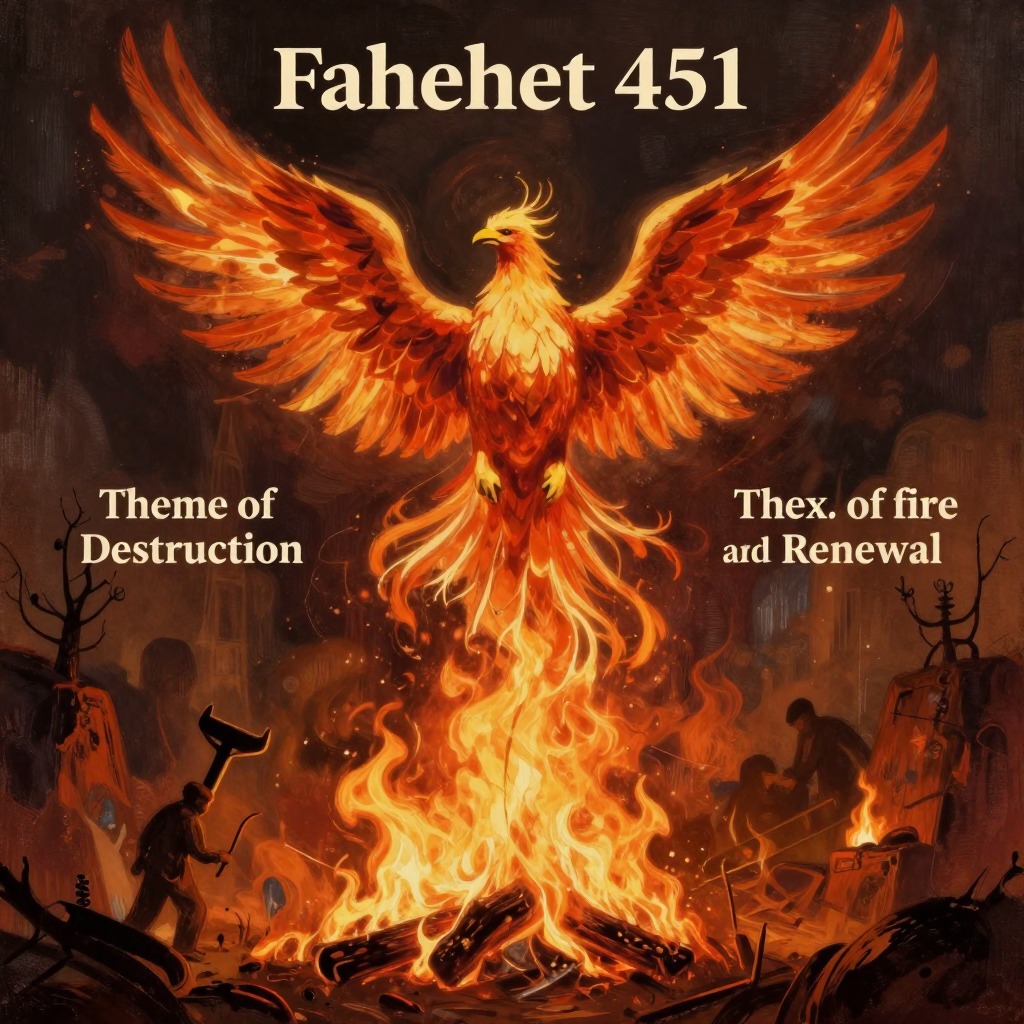
The Phoenix is a central symbol in Ray Bradbury's Fahrenheit 451, appearing both as a physical emblem worn by the firemen and as a mythic figure invoked to frame the novel's meditation on destruction and renewal. The image of the Phoenix—a legendary bird that builds its own pyre, burns itself to ashes, and then rises reborn—captures the paradox at the heart of the story: fire can annihilate, but it can also, under the right conditions, clear the ground for something new. The symbol operates on multiple levels, from the institutional insignia of the firemen to the philosophical vision of the book people who hope to rebuild after the war.
Emblem of the Firemen
The Phoenix appears as a disc on the chest of the firemen's uniforms, alongside the salamander on the arm. When Clarisse McClellan first meets Guy Montag, she is "hypnotized by the salamander on his arm and the phoenix-disc on his chest," recognizing him as a fireman before he speaks. Captain Beatty wears the sign of the Phoenix on his hat, and when he visits Montag's home, he arrives in a "Phoenix car" driven by a man in a black shirt with an orange snake stitched on his arm. The Phoenix thus serves as the firemen's official badge, a mark of their authority and their mission to burn books. Yet the choice of the Phoenix is ironic: the firemen use fire to destroy knowledge, but the Phoenix myth promises that destruction is followed by rebirth—a possibility the firemen's system is designed to prevent.
The Mythic Phoenix and Human Folly
After the bombing of the city, Granger, the leader of the book people, explicitly connects the Phoenix to human history. He tells Montag, "There was a silly damn bird called a Phoenix back before Christ: every few hundred years he built a pyre and burned himself up. He must have been first cousin to Man. But every time he burnt himself up he sprang out of the ashes, he got himself born all over again. And it looks like we're doing the same thing, over and over, but we've got one damn thing the Phoenix never had. We know the damn silly thing we just did." Granger's speech transforms the Phoenix from a symbol of cyclical destruction into a symbol of the possibility of learning. Unlike the mythical bird, which repeats its self-immolation without memory, humans can remember their mistakes and, perhaps, break the cycle. The Phoenix thus becomes a figure of hope tempered by tragic awareness: humanity may keep burning itself, but it also has the capacity to remember and change.
The Phoenix and Montag's Transformation
Montag's own journey mirrors the Phoenix pattern. He begins as a fireman who takes "a special pleasure to see things eaten, to see things blackened and changed," but after meeting Clarisse, witnessing the old woman's suicide, and killing Beatty, he is forced to confront the emptiness of his life. He tells Mildred, "I'm so damned unhappy, I'm so mad, and I don't know why I feel like I'm putting on weight. I feel fat. I feel like I've been saving up a lot of things, and don't know what. I might even start reading books." His old self—the obedient, happy fireman—must be burned away before he can become a keeper of knowledge. When he joins Granger's group, he is told that he is now "the Book of Ecclesiastes," a living repository of a text that speaks of cycles and seasons. The Phoenix's death-and-rebirth pattern is enacted in Montag's psychological and moral transformation.
The Phoenix and the Book People
The book people themselves embody the Phoenix principle. They have memorized entire books, burning the physical copies to avoid detection, and now carry the knowledge in their heads. Granger explains, "We're book-burners, too. We read the books and burnt them, afraid they'd be found." They have destroyed the material form to preserve the content, a kind of controlled burning that allows for future rebirth. When the war ends, they plan to "build a mirror-factory first and put out nothing but mirrors for the next year and take a long look in them," suggesting that self-reflection—the opposite of the firemen's mindless destruction—is the first step toward renewal. The Phoenix symbol thus unites the novel's themes of destruction, memory, and the possibility of starting over, even after the worst has happened.